English
 Deutsch
 Français
 Español


From Event to Action: Faster Control Room Response When Every Second Counts
In a mission-critical control room, detecting an incident is only the beginning. The real measure of an effective response is what happens next: how quickly operators can understand the situation, access the right information, and take action.
When every second counts, even a few extra steps — searching for the right camera, switching applications, locating supporting data, or reconfiguring a video wall — can slow the response.
Security platforms, analytics systems, sensors, and other operational technologies can now detect events ranging from motion in a restricted area to a vehicle of interest identified by license plate recognition (LPR), an access-control alarm, or a potential weapon detected by an AI-enabled security system.
But detecting an event is not enough. The real challenge is closing the gap between detection and action.
Event-driven workflows help close that gap by automatically bringing the right information forward when an incident occurs. In most deployments, the workflow logic is defined and managed within the VMS or another operational platform. Through integration with VuWall, those workflow instructions can then extend into the visualization environment, determining what content appears, where it appears, and how it is presented to operators.
The Critical Seconds After an Alert
Consider a typical security operations center.
An LPR system identifies a vehicle on a watchlist entering a facility. Traditionally, the system generates an alert and the operator must then determine where the vehicle is located, find the associated camera, open the appropriate video feed, and potentially bring additional applications or information onto the video wall.
Every one of those steps takes time.
With an event-driven workflow configured within the VMS or integrated security platform, the LPR event can initiate a predefined response. The platform can send commands to the visualization system to bring the relevant camera onto the video wall, change the control room layout, highlight the incident or display supporting information.
The same concept can apply to many different events:
- A motion sensor detects activity in a restricted area.
- Video analytics identify an object or behavior requiring attention.
- A weapon-detection system generates an alert.
- An access-control system detects an unauthorized entry.
- An operational monitoring system identifies a critical equipment condition.
- A VMS or other third-party platform generates an alarm.
- A 911 center or public safety answering point (PSAP) receives a priority incident requiring multiple information sources to be brought forward.
- A transportation, utility, or other critical-infrastructure system detects an operational condition requiring immediate attention.
Instead of simply alerting the operator that something happened, integrated systems can help prepare the visualization environment for what comes next — automatically bringing relevant information into view based on the predefined workflow.
Extending VMS Workflows Into the Visualization Environment
This is where centralized visualization and control become especially important. VuWall’s TRx centralized management software provides a common environment for managing video walls, displays, AV-over-IP sources, operator workstations, KVM systems, and third-party integrations.
When a VMS or another operational platform detects an event and executes a predefined workflow, its integration with TRx can extend those instructions into the visualization environment. This allows the appropriate content, layouts, and visual cues to be presented automatically across shared displays and operator environments without requiring the operator to manually reconfigure the video wall.
For example, a VMS-generated alert or event can instruct TRx to:
- Display the associated camera or content on the video wall.
- Position content in a specific area of the wall.
- Change a video wall layout to emphasize an incident.
- Add visual cues, such as a colored border, to draw operator attention.
- Route relevant information to specific displays or operator positions.
TRx integrates with leading video management platforms including Genetec Security Center and Milestone XProtect, allowing video wall operations to become part of the operator’s existing security workflow rather than a separate system that must be managed independently.
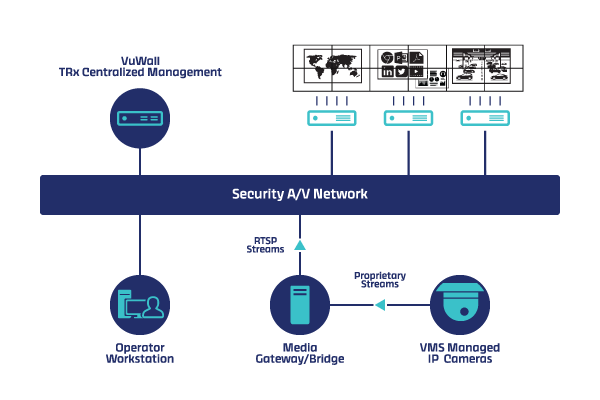
The workflow logic itself is typically defined and configured by the VMS administrator, integrator, or end user based on the organization’s operational requirements. VuWall provides the visualization and control capabilities that allow those workflows to extend across shared displays, video walls, and operator environments.
This distinction is important: the VMS or operational platform determines the response logic, while TRx helps translate those instructions into the visual experience operators need to understand and respond to the event.
From Visualization to Interaction
Displaying the right information is one part of the response. Operators may also need to take immediate control of the systems associated with that event. This is where the integration between VuWall visualization technology and G&D KVM solutions becomes particularly powerful.
G&D KVM systems provide operators with secure access to critical computers and applications while keeping computing hardware centralized and protected. Through G&D’s IP-Control-API and scripting capabilities, KVM switching scenarios can also be integrated into broader operational workflows.
A triggered workflow can therefore go beyond changing what appears on the video wall. It can help create a coordinated operator environment in which the relevant information is brought forward on shared displays while the systems or applications needed to investigate and respond are made accessible at the operator workstation.
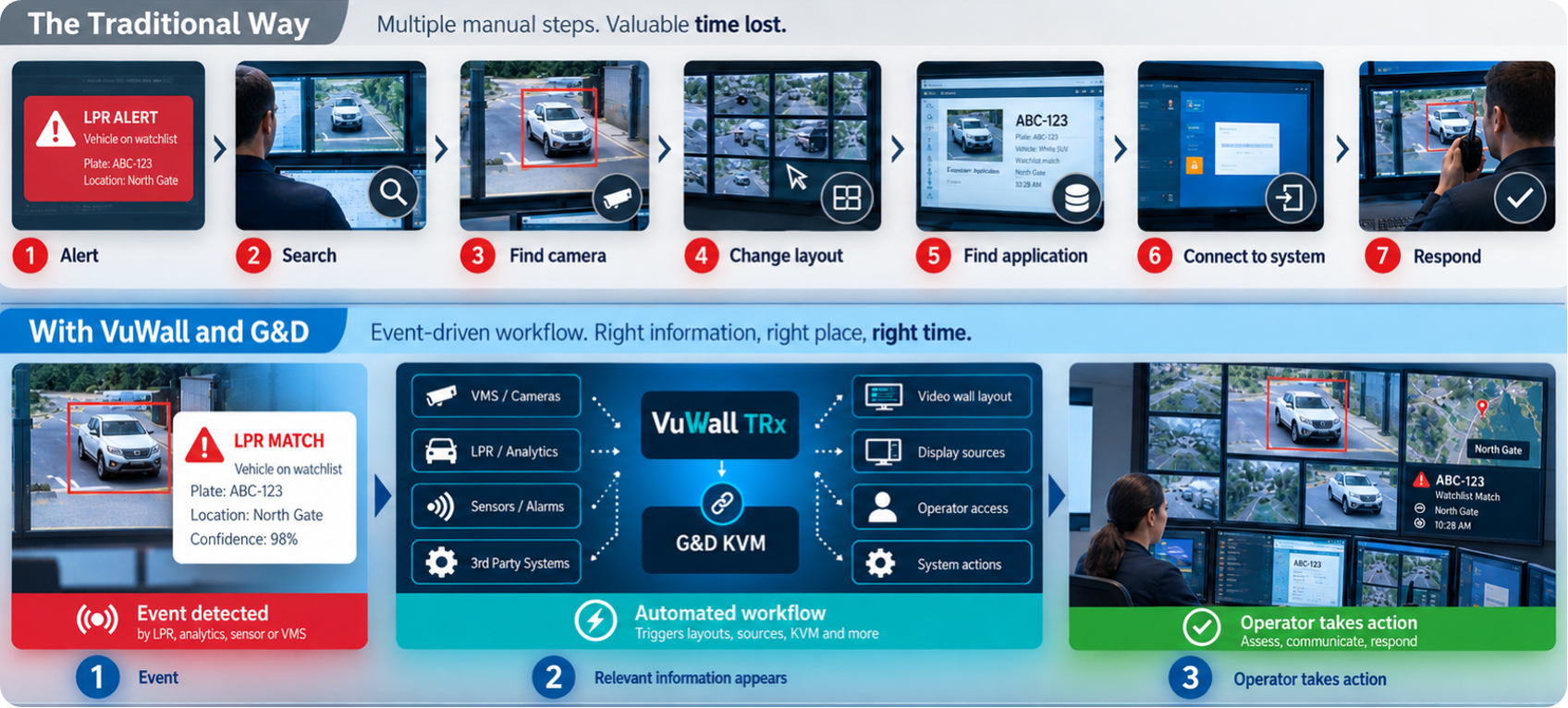
By eliminating unnecessary steps between alert and action, operators can begin responding sooner — a critical advantage when every second matters.
Automation Should Support the Operator — Not Replace the Operator
The objective of workflow automation in the control room is not to remove human decision-making. It is to remove unnecessary steps surrounding that decision.
Operators are increasingly responsible for monitoring a growing number of cameras, applications, dashboards, sensors, alarms, and communications systems. During a significant incident, they may also be managing several events simultaneously.
Every manual task adds cognitive load.
By automatically presenting the most relevant information and preparing the appropriate operational environment, event-driven workflows allow operators to spend less time navigating technology and more time evaluating the situation.
The operator remains in control.The technology helps reduce the friction surrounding the decision by ensuring that relevant information is presented quickly, clearly, and in the right operational context.
Getting the Right Information to the Right Operator — Automatically
As analytics and AI become more widely deployed across security and operational environments, the number of systems capable of detecting significant events will continue to increase.
That makes integration increasingly important.
A control room filled with intelligent systems that operate independently can still leave operators responsible for connecting all the dots. The next step is creating a more coordinated environment where detection, visualization, access, and response work together seamlessly.
Open architectures and APIs are critical to making that possible. Rather than requiring organizations to replace their VMS, access-control platform, analytics engine, sensors, or other operational technologies, integrations with VuWall TRx allow those systems to extend their workflows into the visualization and operator-control environment.
The result is not simply more automation. It is a more connected operational environment in which information can move from the system that detects an event to the displays and operator positions where it can be understood and acted upon.
Together, VuWall and G&D extend that approach from the video wall to the operator workspace, combining centralized visualization, AV distribution, and secure KVM access within an integrated control room ecosystem.
The Goal: Faster, More Confident Response
The value of event-to-action workflows ultimately comes down to one simple objective:
Reduce the time between knowing something happened and being ready to act on it.
When a system detects an event, operators should not have to spend valuable time searching for the corresponding camera, application, or data source. The control room should help bring that information to them.
By integrating VMS-driven workflows with centralized visualization, third-party systems, and secure KVM access, VuWall and G&D help organizations create operational environments where the right information moves quickly and securely from detection to decision — and from event to action.
Let’s Talk About Your Operational Challenges
Every mission-critical environment is different. Meet with a VuWall expert to discuss how your existing systems, workflows, and visualization infrastructure can work together to help operators respond faster and more confidently. Request a free online demo to see how VuWall can support your control room environment.
Additional Resources:
- Learn more about VuWall and Genetec Integration
- Learn more about VuWall and Milestone Integration
- Security Industry Association: “Stop Automating the Wrong Work”
- Security Industry Association: “Creating Your Modern Physical Security Stack”