English
 Deutsch
 Français
 Español


Del evento a la acción: una respuesta más rápida en la sala de control cuando cada segundo cuenta
En una sala de control de misión crítica, detectar un incidente es solo el comienzo. La verdadera medida de una respuesta eficaz es lo que sucede después: con qué rapidez los operadores pueden comprender la situación, acceder a la información correcta y tomar medidas.
Cuando cada segundo cuenta, incluso unos pocos pasos adicionales —buscar la cámara adecuada, cambiar de aplicación, localizar datos de respaldo o reconfigurar un videomural— pueden ralentizar la respuesta.
Las plataformas de seguridad, los sistemas de análisis, los sensores y otras tecnologías operativas ahora pueden detectar eventos que van desde el movimiento en un área restringida hasta un vehículo de interés identificado mediante el reconocimiento de matrículas (LPR), una alarma de control de acceso o un arma potencial detectada por un sistema de seguridad habilitado por inteligencia artificial.
Pero detectar un evento no es suficiente. El verdadero reto es cerrar la brecha entre la detección y la acción.
Los flujos de trabajo basados en eventos ayudan a cerrar esa brecha al presentar automáticamente la información correcta cuando ocurre un incidente. En la mayoría de las implementaciones, la lógica del flujo de trabajo se define y gestiona dentro del VMS u otra plataforma operativa. Mediante la integración con VuWall, esas instrucciones de flujo de trabajo pueden extenderse al entorno de visualización, determinando qué contenido aparece, dónde aparece y cómo se presenta a los operadores.
Los segundos críticos después de una alerta
Considere un centro de operaciones de seguridad típico.
Un sistema LPR identifica un vehículo en una lista de vigilancia que ingresa a una instalación. Tradicionalmente, el sistema genera una alerta y el operador debe determinar entonces dónde se encuentra el vehículo, buscar la cámara asociada, abrir la transmisión de video correspondiente y, potencialmente, llevar aplicaciones o información adicional al videomural.
Cada uno de esos pasos lleva tiempo.
Con un flujo de trabajo basado en eventos configurado dentro del VMS o de la plataforma de seguridad integrada, el evento de LPR puede iniciar una respuesta predefinida. La plataforma puede enviar comandos al sistema de visualización para llevar la cámara pertinente al videomural, cambiar la distribución de la sala de control, resaltar el incidente o mostrar información de respaldo.
El mismo concepto se puede aplicar a muchos eventos diferentes:
- Un sensor de movimiento detecta actividad en un área restringida.
- Los análisis de vídeo identifican un objeto o comportamiento que requiere atención.
- Un sistema de detección de armas genera una alerta.
- Un sistema de control de acceso detecta una entrada no autorizada.
- Un sistema de monitoreo operativo identifica una condición crítica del equipo.
- Un VMS u otra plataforma de terceros genera una alarma.
- Un centro 911 o punto de respuesta de seguridad pública (PSAP) recibe un incidente prioritario que requiere que se presenten múltiples fuentes de información.
- Un sistema de transporte, servicios públicos u otra infraestructura crítica detecta una condición operativa que requiere atención inmediata.
En lugar de simplemente alertar al operador de que algo ha sucedido, los sistemas integrados pueden ayudar a preparar el entorno de visualización para lo que viene a continuación — mostrar automáticamente información relevante según el flujo de trabajo predefinido.
Extensión de los flujos de trabajo de VMS en el entorno de visualización
Aquí es donde la visualización y el control centralizados cobran especial importancia. VuWall Software de gestión centralizada TRx proporciona un entorno común para gestionar videowalls, pantallas, fuentes AV-over-IP, estaciones de trabajo de operadores, sistemas KVM e integraciones de terceros.
Cuando un VMS u otra plataforma operativa detecta un evento y ejecuta un flujo de trabajo predefinido, su integración con TRx puede extender esas instrucciones al entorno de visualización. Esto permite que el contenido, los diseños y las señales visuales apropiados se presenten automáticamente en las pantallas compartidas y en los entornos de los operadores sin necesidad de que el operador reconfigure manualmente el videowall.
Por ejemplo, una alerta o evento generado por el VMS puede ordenar a TRx que:
- Muestra la cámara o el contenido asociado en el videowall.
- Coloca el contenido en un área específica de la pared.
- Cambiar la disposición de un videomural para destacar un incidente.
- Añada indicadores visuales, como un borde de color, para atraer la atención del operador.
- Enrutar información relevante a pantallas específicas o posiciones de operador.
TRx se integra con las principales plataformas de gestión de video, incluidas Centro de seguridad Genetec así como a Hito XProtect, lo que permite que las operaciones del videowall formen parte del flujo de trabajo de seguridad existente del operador en lugar de ser un sistema independiente que deba gestionarse por separado.
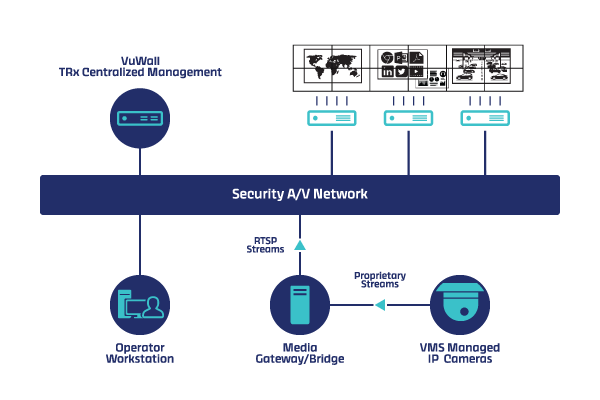
La lógica del flujo de trabajo suele ser definida y configurada por el administrador del VMS, el integrador o el usuario final en función de los requisitos operativos de la organización. VuWall ofrece las capacidades de visualización y control que permiten que dichos flujos de trabajo se extiendan a través de pantallas compartidas, videowalls y entornos de operadores.
Esta distinción es importante: el VMS o plataforma operativa determina la lógica de respuesta, mientras que TRx ayuda a traducir esas instrucciones en la experiencia visual que los operadores necesitan para comprender y responder al evento.
De la visualización a la interacción
Mostrar la información correcta es solo una parte de la respuesta. Es posible que los operadores también necesiten tomar el control inmediato de los sistemas asociados con ese evento. Aquí es donde la integración entre Tecnología de visualización de VuWall y Soluciones KVM de G&D se vuelve especialmente potente.
Los sistemas KVM de G&D proporcionan a los operadores acceso seguro a ordenadores y aplicaciones críticos mientras mantienen el hardware informático centralizado y protegido. A través de la API IP-Control y las capacidades de scripting de G&D, los escenarios de conmutación KVM también se pueden integrar en flujos de trabajo operativos más amplios.
Por lo tanto, un flujo de trabajo activado puede ir más allá de cambiar lo que aparece en el videowall. Puede ayudar a crear un entorno de operador coordinado en el que la información relevante se presenta en las pantallas compartidas, mientras que los sistemas o aplicaciones necesarios para investigar y responder se ponen a disposición en la estación de trabajo del operador.
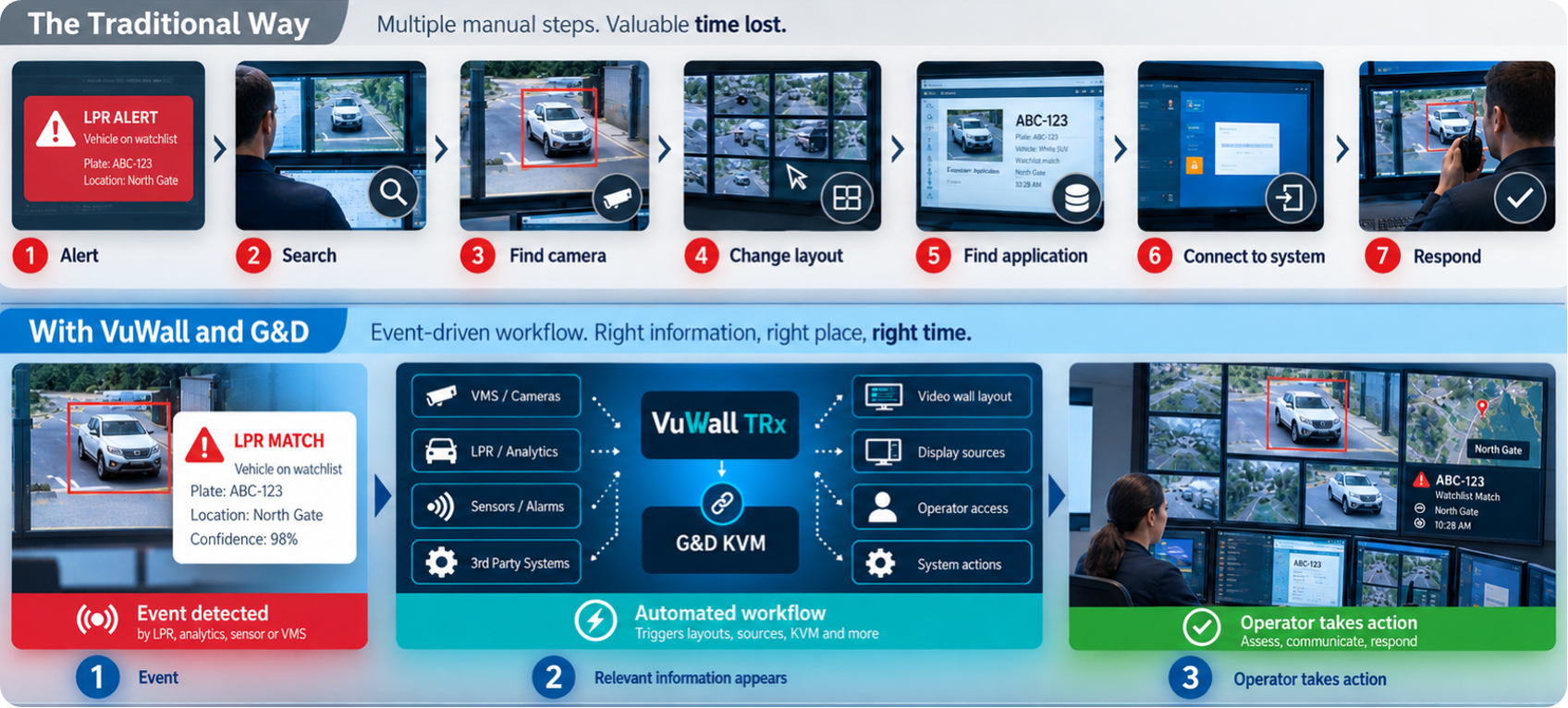
Al eliminar los pasos innecesarios entre la alerta y la acción, los operadores pueden comenzar a responder antes — una ventaja crucial cuando cada segundo importa.
La automatización debe apoyar al operador, no reemplazarlo
El objetivo de la automatización de flujos de trabajo en la sala de control no es eliminar la toma de decisiones humana. Es eliminar pasos innecesarios que rodean esa decisión.
Los operadores son cada vez más responsables de supervisar un número creciente de cámaras, aplicaciones, paneles de control, sensores, alarmas y sistemas de comunicaciones. Durante un incidente importante, también pueden estar gestionando varios eventos simultáneamente.
Cada tarea manual añade carga cognitiva.
Al presentar automáticamente la información más relevante y preparar el entorno operativo adecuado, los flujos de trabajo basados en eventos permiten a los operadores pasar menos tiempo navegando por la tecnología y más tiempo evaluando la situación.
El operador sigue teniendo el control.La tecnología ayuda a reducir la fricción en torno a la decisión al garantizar que la información relevante se presente de forma rápida, clara y en el contexto operativo adecuado.
Llevar la información correcta al operador adecuado: de forma automática
A medida que la analítica y la inteligencia artificial se implementan más ampliamente en los entornos de seguridad y operativos, el número de sistemas capaces de detectar eventos significativos continuará aumentando.
Eso hace que la integración sea cada vez más importante.
Una sala de control llena de sistemas inteligentes que operan de forma independiente aún puede dejar a los operadores la responsabilidad de conectar todos los puntos. El siguiente paso es crear un entorno más coordinado donde la detección, la visualización, el acceso y la respuesta trabajan juntos a la perfección.
Las arquitecturas abiertas y las API son fundamentales para hacerlo posible. En lugar de requerir que las organizaciones reemplacen su VMS, plataforma de control de acceso, motor de análisis, sensores u otras tecnologías operativas, las integraciones con VuWall TRx permiten que esos sistemas extiendan sus flujos de trabajo al entorno de visualización y control del operador.
El resultado no es simplemente más automatización. Es un entorno operativo más conectado en el que la información puede fluir desde el sistema que detecta un evento hasta las pantallas y los puestos de operador donde puede ser comprendida y sobre la cual se puede actuar.
Juntos, VuWall y G&D amplían ese enfoque desde el videowall hasta el espacio de trabajo del operador, combinando la visualización centralizada, la distribución de AV y el acceso KVM seguro dentro de un ecosistema de sala de control integrado.
El objetivo: Respuesta más rápida y segura
El valor de los flujos de trabajo de evento a acción se reduce en última instancia a un objetivo simple:
Reduce el tiempo entre saber que algo sucedió y estar listo para actuar al respecto.
Cuando un sistema detecta un evento, los operadores no deberían tener que perder un tiempo valioso buscando la cámara, la aplicación o la fuente de datos correspondiente. La sala de control debe ayudar a llevarles esa información.
Mediante la integración de flujos de trabajo impulsados por VMS con visualización centralizada, sistemas de terceros y acceso KVM seguro, VuWall y G&D ayudan a las organizaciones a crear entornos operativos en los que la información correcta se desplaza de rápida y segura desde la detección hasta la decisión, y desde el evento hasta la acción.
Hablemos sobre tus desafíos operativos
Cada entorno de misión crítica es diferente. Reúnase con un experto de VuWall para analizar cómo sus sistemas existentes, flujos de trabajo e infraestructura de visualización pueden trabajar juntos para ayudar a los operadores a responder con mayor rapidez y confianza. Solicite una demostración en línea gratuita para ver cómo VuWall puede respaldar el entorno de su sala de control.
Recursos adicionales:
- Más información Integración de VuWall y Genetec
- Más información Integración de VuWall y Milestone
- Asociación de la Industria de la Seguridad “Deja de automatizar el trabajo equivocado”
- Asociación de la Industria de la Seguridad “Creación de su pila moderna de seguridad física”